First Roads into Catt County
Early settlers followed Iroquois trails
OLEAN --The first roads built by white settlers into Cattaraugus County were simple, rugged paths blazed
by the Holland Land Company, starting in 1798. Over the next two decades, a number of important paths
and roads were constructed in and through the county, and many of them followed the trails laid down by Native Americans.
Before the American Revolution, the Iroquois Nation ruled the region, and they were hostile to foreigners.
Their main trail across the Southern Tier was called the Forbidden Path (forbidden to non-Iroquoians), which stretched along
the upper Allegheny River to Ceres, up to Andover, along the Canisteo Creek, and eastward to Binghamton. As with most
Indian trails, the Forbidden Path followed bodies of water.
In 1797, a treaty was made between the Iroquois and New York State, and the Euro-American pioneers poured
into the area. During the early 1800s, the Allegheny River became the main gateway to the West, and Olean became a principle
location. Just before and after the War of 1812, a dozen roadways were cut into the wilderness.
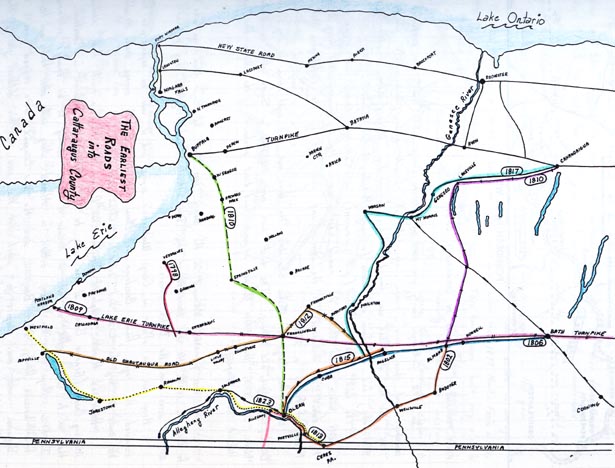
The very first road built by Caucasians into Catt County was the 1798 portage road cleared by the Holland
Land Company's first survey team. It began at Versailles and followed along the Cattaraugus creek to the headwaters
of Conewago Creek. It passed through present-day Perrysburg and Dayton.
In 1802, Benjamin Van Campen (an original member of the HLC team) was hired by Major Adam Hoops to explore
the upper Allegheny River. Starting from his family homestead in Almon, Van Campen traveled to the nearby Dyke Settlement
in Andover, and then hiked to Cerestown, PA. There, he was welcomed by the King family, the first residents of the area.
Trekking through dangerous territory, Benjamin headed down the Oswayo Creek, passed through modern-day Portville
along the Allegheny, and finally reached Olean Point. After spending several months in the wilderness alone, he returned
home and told Major Hoops that Olean would be a great place to settle. His path became the first route to the junction
of Oil (Olean) Creek and the Allegheny River.
In 1806, John Metcalf cut a path from Bath to Angelica. Continuing his work to Olean Point, his team
saw large parties of Seneca hunters, but no white men.
In 1809, work began on the Lake Erie Turnpike, which began at Portland Harbor and ran on a straight line
across Chautauqua, Cattaraugus, Allegany, and Steuben Counties to Bath. Here, there were connections to the Susquehanna
Road, the Great Bend Road, and the Bath Turnpike.
In 1810, starting in Buffalo, a road was created to Springville, through Franklinville, and to Olean, which
was becoming a major hub. In the same year, the first official road was completed from Canadaigua to Lakeville, south
to Dansville, Hornell, and to Olean Point.
The Holland Land Company opened the Old Chautauqua Road in 1812, connecting Allegany County to Farmersville,
Franklinville, Ellicottville, Little Valley, and ending at Mayville.
Benjamin Van Campen's father, Moses, blazed a trail in 1813, which began in Ceres, passed through Portville,
Olean, Salamanca, Jamestown, and finally reached Lake Erie.
In 1815, Moses surveyed another road which connected Angelica to Olean. In 1817, a major road from
Canadaigua to Warsaw to Olean was built. In 1823, a road was developed from Olean to Allegany, followed the Allegheny
River to Pennsylvania, where it connected to a road that arrived in Pittsburgh.
These early pioneer roads were rough, strewn with cut lumber, and only fit for horses. Eventually,
as more people came into the area, improvements were made for wagons and carriages. By 1850, most of the major highways
of the Southern Tier were established.